Tuesday, 30 June 2009

Prince William Sound - seakayaking

A 8-day seakayaking trip in Prince William Sound, from Whittier. Beautiful fjords, impressive (tidal) glaciers, lots of seabirds and marine mammals, rainforest, and a lot of rain. A great trip!

We are not alone here...
We zijn hier niet alleen...
Some beaches are full with dead pine trees, they don't like saltwater.
Sommige stranden staan vol met dode dennebomen, deze houden niet van zout water.

One of the developed campsites, with tent platforms, a pit toilet and bear boxes.
Een van de kampeerplaatsen, met tent platformen, een eenvoudig toilet en beer containers.

Camping in a beautiful rainforest at Decision Point.
Kamperen in een regenwoud in Decision Point.

Camping on a beach with view to a tidal glacier.
Kamperen op een strand met uitzicht op een getijdegletscher.

Campsite in Blackstone Bay.
Kamperen op een strand in Blackstone Bay.

Preparing for take off after camping in Surprise Cove.
Klaar om op pad te gaan na gekampeerd te hebben in Surprise Cove.

Nellie Juan, Culross Passage.

Back on land, on our way back from Whittier, icebergs in Portage Lake.
Terug aan wal op de terugweg van Whittier, ijsbergen in Portage Lake.


Turnagain Arm, southwest of Anchorage, has one of the biggest tidal range in the world.
Turnagain Arm, ten zuidwesten van Anchorage, heeft een van de grootste getijdeverschillen in de wereld.


Between Anchorage and Fairbanks, the Chulitna river with the Alaska Range in the background.
Tussen Anchorage en Fairbanks, de Chulitna rivier met de Alaska Range in de achtergrond.

Alaska Range.

Sunday, 14 June 2009

Fairbanks #4, around Fairbanks

American robin. They have a nest on the side of our house, with 4 young ones.

Creamer's field, where large numbers of birds stop over during spring migration. Popular with sandhill cranes and Canada geese.
 
One of our frequent visitors, the black-eyed junco.

It changed from white to green in a few weeks, view from our balcony.

'Our' house.

Spring visitor on the window.

The very popular walk to Angel rocks.

Spring is here.

Angel rocks.

Getting water at the local spring.

Fox spring.

Typical Fairbanks view, green forested hills; Chatanika valley.

One of many rivers, the Chatanika river.

Without Felix Pedro, who found the first gold in the Fairbanks area, Fairbanks may not have been here.

Wednesday, 6 May 2009

Fairbanks #3, around Fairbanks

Spring has come! After 2 weeks with warm weather with several days over 20˚C most of the snow around Fairbanks has now melted and the birch trees are starting to sprout their leaves. Very little in terms of spring flowers though, nothing like Tromsø. The warm weather is also causing the rivers to break up, with some severe flooding along the Yukon river. The village Eagle some 200 km southeast of Fairbanks is being swiped away by enormous ice blocks in the worst flooding in recorded history (see photos on: http://newsminer.com/photos/galleries/2009/may/05/2009-breakup-flooding/2030/). Also the Chena river, which flows through the centre of Fairbanks, showed a spectacular breakup flooding on Saturday. We missed it, unfortunately, as we were hiking up in the hills, but saw a photo in the local newspaper (http://newsminer.com/photos/galleries/2009/may/05/2009-breakup-flooding/2019/).

Below is a selection of photos from around Fairbanks, moose walking around the house, skiing in the Delta Range 150 km south of Fairbanks, Denali national park and some photos of the local hills.


Moose around the house

Moose around the house (taken from bedroom window)

Breakup in Denali national park

Railway bridge, Alaska range

Dall sheep

Camping on the Castner glacier

Skiing down from Triangle Peak towards Castner glacier

'Girl's' trip to Castner glacier and Thayer hut

Thayer hut

White mountains, north of Fairbanks

Near Chena Hot Springs, west of Fairbanks

Tanana river, just south of Fairbanks

Hiking up Murphy Dome in 23˚C on May 2nd

Sunday, 12 April 2009

Fairbanks #2, Nome and the Iditarod

In the middle of March we went to Nome for a couple of days to see the first Iditarod dog teams come in. Nome, in western Alaska, is the finish for the 1049 mile (ca 1700 km) Iditarod dogsled race from Anchorage; it is also the commercial centre for northwest Alaska. Nome started as a gold mining town, it became famous in 1899 when gold was found on the beach and in 1900 it was the largest city in Alaska with about 20000 inhabitants. This number has now dropped to about 2000 inhabitants, but there is still gold mining in the area and it is still possible to pan for gold on the beach. Nome is on the coast and therefore windier than Fairbanks, so it felt a lot colder. The first 1.5 days, waiting for the Iditarod winner to arrive, we explored Nome, visited the museum, went to a performance of the local King Island dancers, walked on the sea ice and 'explored' the Nome 'national forest' (they plant old Christmas trees and large animal statues on the sea ice). And, of course, we kept checking the status of the Iditarod teams, many of which had decided to shelter from the major storm battering the coast and the Yukon river in these days. Wednesday morning, however, the town's firealarm went off, indicating a dog team approaching Nome, and we raced down to the finish chute to see Lance Mackey arriving with 15 dogs to become the Iditarod winner for the third year in a row. From now on, every time a new dog team approached Nome, the firealarm would go off and tourists and locals would come out of the hotels, pubs and workplaces to cheer the incoming team to the finish. A great atmosphere, although the TV teams and reporters were a nuisance, crowding around the dogs and sled blocking the view for others. On Thursday morning we volunteered to work the early morning shift in the dog lot, taking care of dropped dogs and helping the vets to check the incoming dog teams. A great trip!
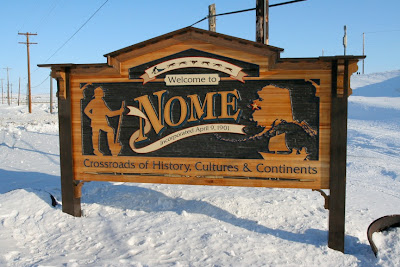
Welcome to Nome

A familiar face: Roald Amundsen. He landed near Nome with his airship Norge after the first transpolar flight in 1926.
Een bekend gezicht: Roald Amundsen, de beroemde Noorse poolreiziger landde in 1926 in de buurt van Nome met de zeppelin Norge na de eerste succesvolle vlucht over de noordpool.

A performance by the Kong Island dancers and musicians.
Een voorstelling van de King Island dansers en muzikanten.

The Nome 'national forest'
Het 'nationale bos' van Nome

Iditarod 2009 winner Lance Mackey arriving at the finish
Aankomst van Iditarod 2009 winnaar Lance Mackey 

Lance Mackey's two leaddogs get some well deserved attention
Lance Mackey's twee leiders krijgen wel verdiende aandacht

Different means of transport for different seasons
Transport type hangt af van het seizoen

Sebastian Schnuelle, with his father, on their way to park his dog team after finishing number 2
Sebastian Schnuelle, en zijn vader, op weg naar de hondenrustplaats nadat hij als tweede is binnengekomen

Gold dredge
Goudbaggermachine

Running up the bank from the sea ice...
Vanaf het zeeijs omhoog rennen...

... onto the main street in Nome to the finish line
...naar de hoofdstraat van Nome op weg naar de finish

View of the hills in western Alaska from the plane
Uitzicht over de heuvels in west Alaska vanuit het vliegtuig

View of the mighty Yukon river
Uitzicht over de Yukon rivier

View of Denali
Uitzicht naar Denali